For most warehouse import programs, a 2 ton electric forklift is a practical starting point when the regular pallet load stays below 2,000 kg, the pallet size is predictable, and the work is mainly on flat warehouse or factory floors. A 3 ton electric forklift becomes the better choice when loads often approach 2,500-3,000 kg, when pallet weight is inconsistent, or when the buyer wants more reserve capacity for mixed industrial handling.
This guide is written for importers, distributors, brand owners and procurement managers comparing electric counterbalance forklifts for Asian, African and Latin American markets. It uses Juwang Machinery’s published electric forklift range as the product reference: CPD-20C, CPD-25E, CPD-30A and CPD-35D models listed in the electric forklifts category. Where a detail is not publicly stated on the product pages, the article treats it as a point to confirm rather than an assumed specification.
When a 2 Ton Electric Forklift Is the Right Starting Point
A 2 ton electric forklift is usually suitable when the buyer handles standard palletized goods, packed raw materials, cartons, consumer products, light manufacturing components or warehouse inventory that does not regularly exceed the rated load. For importers building a general warehouse equipment catalog, the 2,000 kg capacity class is easy for customers to understand and often fits light to medium-duty applications.
Capacity should not be selected only by the heaviest pallet in a product list. Buyers should also consider how often that heavy pallet appears, whether the pallet is evenly loaded, how far the forklift travels with the load, and whether the forklift needs to lift to rack height. If 80-90% of customer applications are below 1,500-1,800 kg and the operation uses normal pallets on flat floors, a 2 ton electric forklift can be a sensible option to quote first.
Juwang’s CPD-20C product page confirms a maximum lifting capacity of 2,000 kg, 60V electric power, 1220 mm forged forks, solid tires and a 3 m lifting height listed as customizable. That combination makes the model relevant for warehouses, logistics centers and factory handling where the buyer wants an electric counterbalance forklift rather than an electric stacker or pallet truck.
When to Move Up to a 2.5 Ton, 3 Ton or 3.5 Ton Model
Moving up in capacity is not only about lifting a heavier pallet once. It is about reducing mismatch risk when loads vary, operators handle mixed goods, or the buyer cannot fully control customer use after resale. A 2.5 ton electric forklift gives more headroom for distributors serving customers whose pallet weight often exceeds 2,000 kg but does not require the heavier frame and power level of a 3 ton unit.
A 3 ton electric forklift should be considered when the buyer handles heavier industrial goods, dense raw materials, construction supplies, drums, molds or production materials where actual loaded pallets can approach 3,000 kg. The CPD-30A page confirms a 3,000 kg maximum lifting capacity, 60V voltage, 7500W walking motor and 5000W hydraulic lifting motor. Those figures support a heavier-duty positioning than the CPD-20C or CPD-25E.
A 3.5 ton electric forklift is a more specialized selection for buyers who need the upper end of Juwang’s published electric counterbalance range. The CPD-35D page confirms 3,500 kg maximum lifting capacity, 10000W walking motor and 7000W hydraulic lifting motor. For importers and dealers, this model should be quoted when the customer clearly needs higher capacity, wider reserve margin or heavier industrial handling. It should not be substituted automatically for a lighter application because a larger machine may affect budget, shipping weight, aisle planning and operating space.
What Specifications Should Buyers Compare Before Choosing Capacity?
The main specifications to compare are rated capacity, actual load weight, pallet dimensions, load center, lift height, forklift own weight, battery voltage, motor power, fork length, tire type and working environment. These items are more useful than a simple question such as “Do you want 2 ton or 3 ton?” because they reveal whether the forklift fits the customer’s real operation.
| Model | Published Capacity | Published Voltage | Walking Motor | Hydraulic Lifting Motor | Fork Length | Published Vehicle Weight | Best-Fit Buying Scenario |
|---|---|---|---|---|---|---|---|
| CPD-20C | 2,000 kg | 60V | 4000W | 3000W | 1220 mm forged forks | 2850 kg | Medium-duty warehouse and logistics handling where normal loads stay within 2,000 kg |
| CPD-25E | 2,500 kg | 60V | 5000W | 4000W | 1220 mm forged forks | 3350 kg | Customers needing more reserve than a 2 ton electric forklift without moving to 3 ton |
| CPD-30A | 3,000 kg | 60V | 7500W | 5000W | 1220 mm forged forks | 3850 kg | Heavy warehouse, factory and industrial handling where loads may approach 3,000 kg |
| CPD-35D | 3,500 kg | 60V | 10000W | 7000W | 1220 mm forged forks | 4350 kg | Higher-capacity industrial handling where the customer needs the top published electric model |
The table is based on specifications published on Juwang’s product pages. It should be used as a shortlisting tool, not as a final engineering approval. For unusual loads, attachments, long pallets or high-lift applications, buyers should confirm the final model with the supplier before ordering.
How Load Center, Lift Height and Attachments Change the Real Choice
The rated capacity on a forklift page is only one part of capacity selection. Load center and load shape can change whether the selected forklift is suitable. Safety guidance from the Canadian Centre for Occupational Health and Safety advises users not to exceed the recommended load limit shown on the lift truck data plate and to position loads according to the recommended load centre. This is why a long, uneven or forward-positioned pallet may require more capacity than its weight alone suggests.
The same guidance notes that the load limit decreases as the load centre is raised. This matters for B2B buyers because procurement teams often know pallet weight but forget pallet length, overhang, load distribution and lift height.
If a customer compares a 2 ton electric forklift with a 3 ton model, ask for the longest load dimension, the normal load center, the required lift height and whether attachments will be used. Fork extensions, clamps, rotators or special fixtures can change the load center and should be confirmed with the forklift supplier. When this information is unavailable, it is safer to pause the quotation and request details than to assume the smaller forklift will remain suitable.
Application Fit in African, Asian and Latin American Markets
Importers serving Africa, Asia and Latin America often sell to mixed-use customers: warehouses, wholesale markets, food and beverage storage, logistics parks, factories, building-material yards and agricultural processing facilities. Many of these buyers want one forklift that can cover several duties. That makes capacity planning more important, because the forklift may be used by different teams after delivery.
For indoor warehouses with smooth concrete floors, a 2 ton electric forklift or 2.5 ton model may be enough when pallet weights are controlled and the daily route is predictable. For factories handling metal parts, raw materials or dense finished goods, a 3 ton electric forklift may reduce the risk of undersizing. For customers who handle loads near 3.5 tons or want a larger reserve, the CPD-35D should be reviewed against aisle width, floor strength, loading dock dimensions and charging arrangements.
Market conditions also affect the decision. In developing distribution networks, the end user may not have a detailed fleet engineer. A dealer’s role is to ask simple but concrete questions: What is the heaviest pallet? What is the normal pallet? How high must the load be lifted? Is the floor flat? Is the forklift used indoors, outdoors or both? These questions help turn a broad inquiry into a usable specification.
Battery, Motor and Charging Checks for Importers
Capacity should be matched with the power system. Juwang’s listed CPD electric forklift models use 60V power, while motor power increases as capacity rises across the published range. The 2 ton CPD-20C lists a 4000W walking motor and 3000W hydraulic lifting motor; the 3 ton CPD-30A lists a 7500W walking motor and 5000W hydraulic lifting motor; the 3.5 ton CPD-35D lists a 10000W walking motor and 7000W hydraulic lifting motor.
For importers and distributors, these motor differences are useful when explaining why capacity classes are not interchangeable. A heavier model is not simply a larger label on the same machine. It can involve different vehicle weight, tire size, frame structure and motor output. Buyers comparing battery voltage and motor output can also read Juwang’s related article on battery voltage and motor power for electric forklift buyers.
Charging details should be confirmed during quotation. Juwang’s published CPD electric forklift pages list 5-8 hours charging time and 6-8 hours continuous working time. Buyers should still confirm charger voltage compatibility, plug type, battery maintenance needs, charging room ventilation requirements where applicable and whether the customer’s duty cycle requires spare charging arrangements.
How to Compare Supplier Quotations Without Looking Only at Capacity
Two electric forklift quotations can look similar when both mention the same rated capacity. They may not be equivalent. Importers should compare the full specification sheet, including forklift model, lifting height, fork length, tire size, battery information, motor power, steering method, brake system, vehicle weight, included accessories and after-sales parts support.
For a 2 ton electric forklift quote, confirm whether the supplier is quoting a counterbalance electric forklift or a stacker. Both may lift 2,000 kg in some configurations, but they are different machines for different work. Counterbalance forklifts are more suitable for pallet loading, unloading, travel and yard-adjacent handling on suitable surfaces, while stackers are mainly used for indoor pallet stacking in narrower warehouse areas.
When a buyer asks for a quick quote, the best response is not just a price line. A serious quotation should show which model is being proposed and why that model fits the stated load, route and lift height. Juwang has a separate guide on what to include in a forklift quotation request, which can help procurement teams prepare a clearer inquiry.
What Documents and Support Should Be Confirmed Before Importing?
Before importing, buyers should request a product specification sheet, product photos or videos, packing information, operation and maintenance information, spare parts list, warranty terms and the correct commercial documents for their import process. The exact customs and conformity requirements vary by destination market, so the buyer should confirm local import rules with the importer, customs broker or local authority.
Do not assume certification, local approval or road-use permission unless it is specifically documented for the exact product and destination country. This is especially important for brand owners and distributors who will resell equipment under their own commercial responsibility. If certification or documentation is required in the destination market, ask the supplier what can be provided before confirming the order.
After-sales support should also be practical. Importers should ask whether common wear parts, lights, tires, controllers, motors, seals and hydraulic parts can be supported for the selected model. For multi-unit orders, a basic spare parts plan may reduce downtime and make the product easier for dealers to service in local markets.
What Information Should You Send for a Reliable Recommendation?
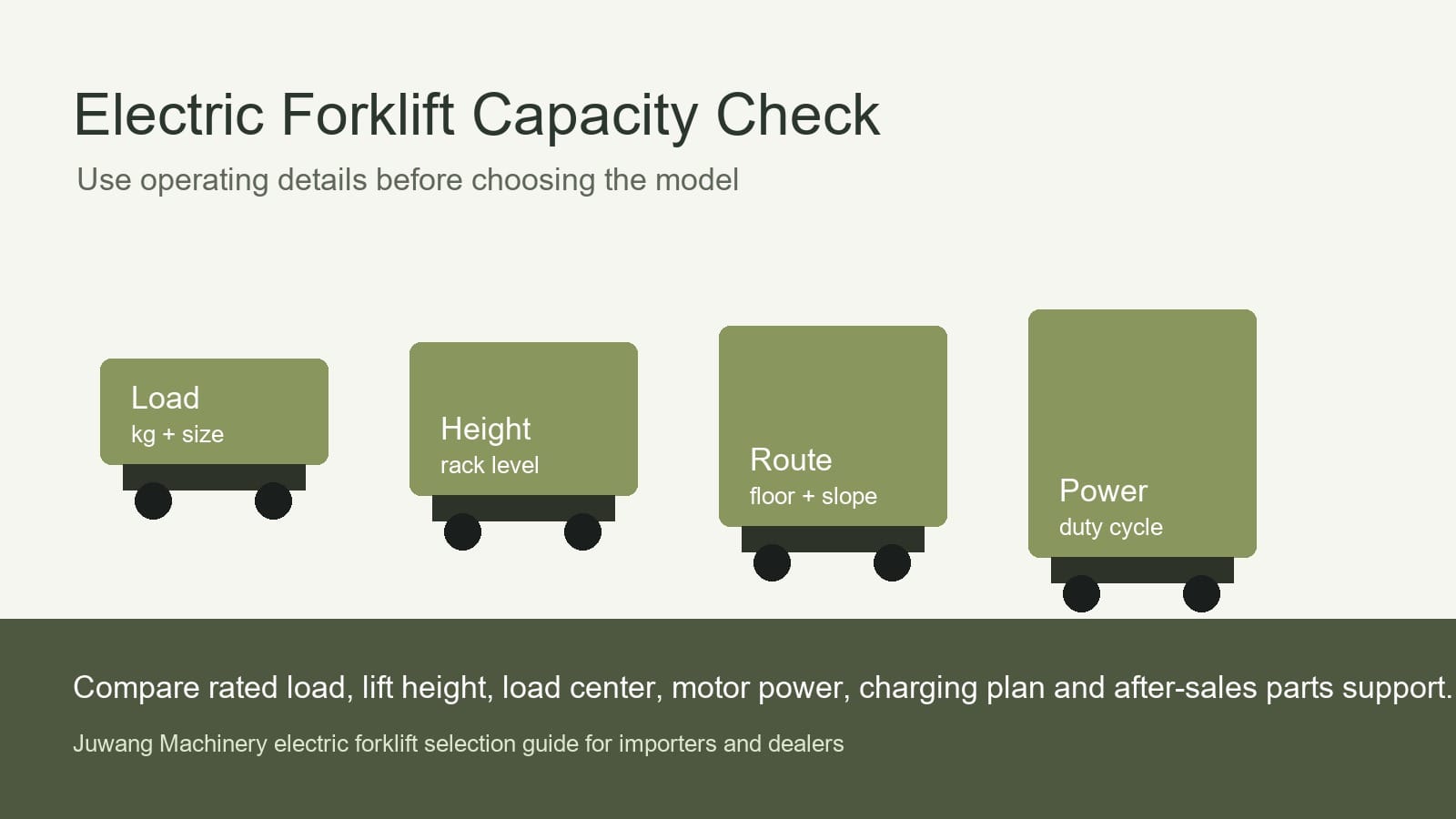
A reliable recommendation starts with operating details. Send the maximum load weight, normal load weight, pallet dimensions, load center if known, required lifting height, aisle width, door height, floor condition, ramp or slope information, daily working hours, charging power availability and whether the forklift will work indoors, outdoors or both.
Photos or short videos of the working area are often useful. They can show floor condition, rack height, loading dock layout, truck container access, turning areas and any narrow passages. The Health and Safety Executive’s lift truck guidance emphasizes management, training, examination and safe use as part of lift truck operation; procurement should therefore consider the working environment and operating control, not just the machine model.
If you are comparing a 2 ton electric forklift, 2.5 ton electric forklift and 3 ton electric forklift for a tender, send all three expected use cases. A supplier can then recommend one standard model, two different models for different customer segments, or a capacity upgrade where the risk of undersizing is high.
Practical CTA for Importers and Dealers
If your customer inquiry is still incomplete, send Juwang Machinery the load weight, pallet size, lift height, floor condition and daily working hours first. The team can help compare the relevant electric forklift models and identify which specifications need confirmation before quotation. For catalog planning, you can also request support through the contact page and explain whether your market needs 2 ton, 2.5 ton, 3 ton or 3.5 ton capacity coverage.
Conclusion
A 2 ton electric forklift is a strong starting point for medium-duty warehouse and factory handling when loads are controlled and the working environment is suitable. A 3 ton model becomes more appropriate when loads are heavier, less predictable or closer to industrial-duty conditions. The right decision depends on real load data, lift height, load center, working surface, motor power, charging needs and after-sales support.
For importers, distributors and procurement managers, the best purchasing process is to compare model specifications before negotiating commercial terms. Use the 2 ton class for controlled medium-duty handling, consider 2.5 ton when extra reserve is needed, move to 3 ton for heavier industrial loads, and review 3.5 ton only when the application clearly requires the higher published capacity.
FAQ
Is a 2 ton electric forklift enough for warehouse use?
It can be enough when regular pallet loads stay within 2,000 kg, pallet dimensions are standard, the floor is flat and the required lift height is within the confirmed model specification. If loads often approach or exceed 2,000 kg, review a 2.5 ton or 3 ton model instead.
How do I choose between a 2 ton and 3 ton electric forklift?
Choose by maximum load weight, normal load weight, load center, lift height, pallet size, travel route and daily duty. If the customer regularly handles loads above the 2 ton range or cannot control load variation, a 3 ton electric forklift may be the safer recommendation.
Does forklift capacity decrease with a longer load?
Yes, capacity can decrease when the load center moves forward or the load is uneven. Buyers should confirm load dimensions and center of gravity before selecting a capacity class, especially for long pallets, machinery parts or attachments.
What should an importer include in an electric forklift inquiry?
Include load weight, pallet size, lift height, aisle width, floor condition, daily working hours, charging power, destination market and whether the forklift works indoors or outdoors. Photos or videos of the site can make the recommendation more accurate.
Can the lifting height be customized on Juwang electric forklifts?
Juwang’s CPD electric forklift product pages list 3 m lifting height as customizable. Buyers should confirm the required lift height, mast configuration and any impact on capacity or shipping dimensions before ordering.